Reserved Seat or General Admission: What Are You Choosing?
Compare reserved seat or general admission by certainty, flexibility, and arrival demands so you can choose tickets that fit the night you want.

The common mistake when choosing reserved seat or general admission is treating the ticket type as a minor detail. It can determine whether you plan around a specific place or around your arrival, and that choice affects the pace of the whole outing.
Think of the decision as a trade between certainty and flexibility. A reserved seat gives you an assigned place; general admission usually gives access to an unassigned area, with position shaped by the venue’s rules and the crowd. Neither is automatically better. The right fit depends on how you want to spend the hours before the music starts.
Start with the night
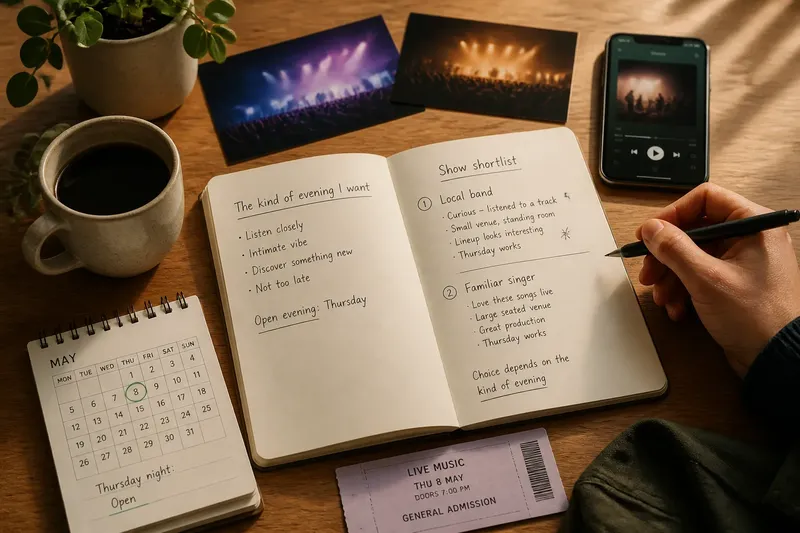
Before buying, picture the evening from the moment you leave home. Would you rather arrive without rushing, find your seat, and settle in? Or would you enjoy getting there early, moving around, and choosing a spot within the permitted area?
Be specific about what matters. You might prioritize sitting, keeping a companion beside you, avoiding a long wait, or being close to the stage. A ticket label alone does not tell you the whole experience, so check the venue’s seating map and the event’s description for details such as standing areas, accessible seating, and whether any sections are mixed.
Write down your main priority before comparing listings. It is easier to judge the trade-off when you know what you are trying to preserve.
Reserved seat or general admission?
A reserved ticket assigns a particular seat or a defined seating place. That makes the location more predictable and can simplify coordinating with a companion who has a nearby seat. It does not necessarily mean the view or comfort will suit you, so check the seat map, sightline notes, and any restrictions shown by the seller or venue.
General admission typically means you enter an area without a specific seat assigned. It can leave more room to choose where to stand or sit if the event allows both, but your options may depend on when you arrive and how the room is arranged. Some general-admission events use a standing floor; others have open seating or separate zones.
The practical contrast is not simply sitting versus standing. A reserved place shifts more of the decision to ticket-buying time, while general admission can shift it to arrival and entry. Read the event details rather than assuming that every venue uses the terms in the same way.
Build a week-of plan
When you buy: Check the seating map or general-admission description, then confirm what the ticket includes. Look for separate entry areas, assigned rows, standing-only restrictions, and any venue information about access needs. Where details depend on the ticket label, venue instructions, or local rules, follow those instructions and ask the venue if anything remains unclear.
A few days before: Decide what arrival time makes sense for your choice. With a reserved seat, you can usually plan around doors and the start time without treating early arrival as a way to claim a location. With general admission, allow time for the entry process and consider whether arriving earlier is worthwhile for the position you hope to get.
The day before: Check the route, transit schedule, and venue entry information. For general admission, agree with your companion on what to do if you arrive separately or get divided in the crowd. For reserved seats, confirm that everyone has the correct section or row information so you do not discover a mismatch at the entrance.
On the day: Keep the plan adaptable. A reserved seat can give you freedom to arrive closer to the performance, while a general-admission ticket may reward a more deliberate arrival. If your energy, transport, or company’s needs change, use the venue’s current guidance instead of trying to force the original plan.
Match the ticket to your habits
Choose a reserved seat if knowing where you will be matters more than choosing your exact position after entry. It may suit someone who prefers to sit, wants a clear rendezvous point, or does not want the evening to revolve around joining an early queue.
Choose general admission if you value movement and are comfortable with some uncertainty about where you will end up. It can suit a person who enjoys standing or wants to explore the room, provided the event’s layout and entry conditions fit that preference.
Imagine you and a friend both want to see the same performance, but one dislikes standing for a long time. If the event offers assigned seating, you could choose adjacent seats and plan a relaxed arrival. If the only option is general admission, you could agree beforehand on a comfortable arrival window and a meeting point outside the entrance; the observable result is a shared plan without assuming that a particular spot will be available.
Questions to settle before buying?
Does general admission mean standing?
Not always. It can refer to an open standing area, unassigned seating, or another arrangement set by the venue, so check the event listing and venue information before deciding.
Can reserved seats still have a limited view?
Yes. An assigned place tells you where you are allocated, not necessarily what you can see from it. Review any view or obstruction notes provided for the specific section.
Can a group mix ticket types?
Sometimes, but people with different ticket types may enter or gather in separate areas. Confirm the venue’s arrangements and agree on a meeting place that does not depend on everyone sharing a section.
Which ticket needs an earlier arrival?
General admission often makes arrival timing more relevant because position may depend on entry order or available space. Reserved seating usually reduces that pressure, though you should still leave time for the venue’s entry process.
Choose for the commitment
Look beyond the advertised view and ask what each ticket asks you to commit to. Reserved seating asks you to choose a location in advance; general admission asks you to accept that location may be decided later, under the conditions of that event.
For a quick decision, compare three things: whether you want a known place, how you feel about arriving early, and whether standing or moving around suits you. If one option clearly fits those preferences, choose it; if the event details leave an important point uncertain, contact the venue before buying.
Reserved seat or general admission is ultimately a choice about when you want to make the important decisions: before the night or as you arrive. Pick the ticket that leaves you with the kind of uncertainty you can comfortably handle, then plan the trip around that choice.