The Group-Chat Trap: Too Many Choices, No Decision
Concert plans stall when every message adds another idea. Use a fair group decision process to surface constraints, settle one question, and choose together.
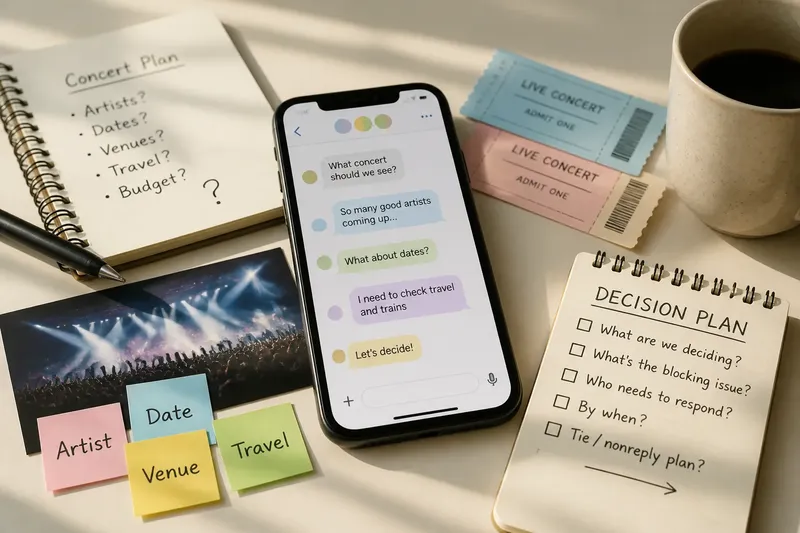
The most common group-chat mistake is asking, “What concert should we see?” and leaving every detail open. Concert plans then sprawl across artists, dates, venues, and travel, while the person coordinating absorbs the work and still has no clear answer.
Instead of building another shortlist, find the one unresolved point blocking this group’s decision. Ask about that point alone, then agree on who needs to respond and how the group will handle a tie or a nonreply.
Find the sticking point
A conversation can look indecisive when the group is actually answering different questions. One friend may be choosing a performer, another may be checking whether the date works, and someone else may be wondering how to get home.
Ask a narrow question that separates those concerns: “Before we decide, is the date, the travel, or the show itself still uncertain?” Let people answer briefly, and invite private replies for sensitive details such as a spending limit.
Then name the blocking issue in the chat. If the date is the problem, pause discussion of performers until the group has agreed how to handle availability.
Set shared ground rules
Before anyone counts votes, agree what the group is deciding and what a valid response looks like. A preference for one performer is not the same as being available that night, and silence does not establish either.
Make room for essential constraints without asking anyone to justify them. A friend can say a date or venue does not work, or decline to explain why; the group can then decide whether to adjust the plan or let that person sit this one out.
Choose a process that fits the issue: a simple vote for a straightforward preference, a conversation for competing needs, or a pause if the group has not agreed what kind of outing it wants.
Share the facilitation
Coordination can fall to the person who first suggests a concert, even when that person does not want to make every decision. Give the facilitator a limited role: state the question, gather responses, and report the outcome without treating a preference as permission to decide for everyone.
Rotate that role if the same person routinely does the organizing. The next facilitator might track replies or ask whether the group wants to proceed, while leaving each person free to opt out.
- Observation: Nobody has named the decision. If the chat mixes performer, date, and travel questions, then ask which one must be settled first; otherwise, move to the stated decision.
- Observation: A friend says a date will not work. If the group wants that person included, then reconsider the date; otherwise, confirm that the person is comfortable sitting this outing out.
- Observation: Someone has a venue-access or travel constraint. If the proposed venue conflicts with it, then choose a workable alternative; otherwise, continue without asking for extra personal details.
- Observation: Replies are split between two preferences. If nobody agreed how to handle a tie, then ask the group to choose a rule; otherwise, apply the agreed rule.
- Observation: Several people have not replied. If the plan depends on their participation, then follow up once and wait; otherwise, proceed only if the group has already agreed that nonresponses do not block the plan.
- Observation: The facilitator is also strongly advocating for one choice. If that preference could sway the discussion, then disclose it and invite independent replies; otherwise, keep the facilitation neutral and record the group’s responses.
Keep the decision fair
State the decision in one sentence and give people a clear way to disagree. For example: “Are we going with Saturday, or does that date rule it out for you?” This keeps the exchange focused without forcing anyone to share more than needed.
A poll can help when everyone understands the options and the question is simply preference. Direct replies work better when someone may need to explain a constraint privately; neither method makes an unavailable person available or turns a nonreply into consent.
Agree on a response point and a tie plan before the conversation stalls. The group might revisit the blocking issue, let only the available friends decide if everyone accepts that arrangement, or leave the outing undecided.
When should the group pause?
What if a friend does not reply?
Send one concise follow-up that states the decision and asks for a response by a clear point in the conversation. If the group has not agreed to proceed without that friend, do not interpret silence as agreement.
How should a tie be handled?
Use a tie rule the group accepted before voting, or ask everyone to choose a process for resolving it. If no option works for enough people, pause rather than letting the facilitator quietly pick a winner.
Can the person organizing make the final call?
Only if the group has agreed that the organizer may do so for this decision. Otherwise, the organizer can facilitate while each person makes their own choice about joining.
What if one person cannot afford the outing?
Share ticket information plainly and let that person set a private limit without explaining it to the group. If the plan does not fit their comfort level, consider another outing or let them decline without pressure.
Work through one decision
Say you are coordinating three friends, and the chat keeps returning to the artist even though nobody has settled the date. One friend says Friday is unavailable, another says Saturday works but needs a venue near a train, and the third is open to either night.
You ask, “Should we rule out Friday and focus on Saturday, or does Saturday not work for anyone?” The first friend confirms that Saturday is possible, the second confirms the train access is essential, and the third agrees to Saturday. The resulting decision is to continue with Saturday and check only whether the venue meets the stated travel need; if no suitable venue is available, the group will reconsider the date rather than pretend the constraint has disappeared.
That exchange settles availability without making anyone disclose a reason or letting the most enthusiastic friend dominate. It also leaves a clear next question, so a new performer suggestion does not restart the whole conversation.
End the loop
When suggestions keep reopening settled ground, acknowledge them and name the current decision: “Let’s keep those ideas for another night; for this plan, we’re deciding whether Saturday works.” If the group cannot answer, ask what single concern remains rather than adding more possibilities.
Once the group reaches a decision, restate what was agreed and what each person still needs to confirm. For concert group planning, a clear “yes,” “no,” or “not this time” is more useful than a crowded chat that leaves everyone guessing.